Frauke Dannert: Doppelgänger

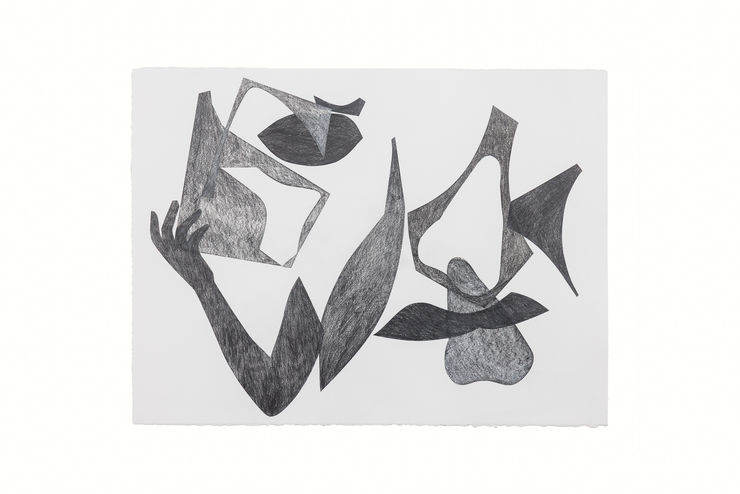
Fingers seem to reach for something elusive. Their silhouettes fall across the wall like shadows, evoking ghostly hands in negative form. They echo small-format paper collages in which graphite-coloured shapes drift, seemingly without direction. The pictorial space resembles the diffuse darkness of thought before words begin to form, or the primal chaos before physical forces came into being. Spaces where anything is possible because they resist fixed definition. Through the artistic process of frottage, real forms press themselves into the collages, flashing up as strangely familiar fragments that reassemble into entirely new constellations – a fragmented reality.
Frauke Dannert (b.1979 in Herdecke, Germany) lives and works at Cologne.
The genesis of Dannert’s practice lies in her interest in the architectural space and the medium of collage. Through this she dissects architecture, examining it as to its sculptural potential and produces creations that oscillate between the organic and the architectonic, illusion and reality. Within her collage practice Dannert creates the initial compositions and then replicates them using a photocopier. By reducing the photocopies to black, white and grey tones she distances the works from the original material reality and alienates spaces and the viewers experience of the space.
Her work can be found in many institutional collections including Museum Kunstpalast, Düsseldorf; Kunstsammlung Deutsche Bundesbank, Frankfurt; and Sammlung Kunst aus NRW (Kornelimünster), Aachen.
-
 Frauke DannertTemplate Paintings, 2025Graphitpigment, dispersion, acrylics on cotton200 x 180 cm
78 3/4 x 70 7/8 in -
Frauke DannertFragile Twin, 2025graphite, papercollage56 x 76 cm
22 x 29 7/8 in -
Frauke DannertFragile Twin, 2025graphite, papercollage56 x 76 cm
22 x 29 7/8 in -
Frauke DannertShoe, 2025Graphitpigment, dispersion, acrylics on cotton109 x 82 cm
42 7/8 x 32 1/4 in -
Frauke DannertTemplate Paintings (M04/26) , 2026Graphitpigment, dispersion, acrylics on cotton200 x 180 cm
78 3/4 x 70 7/8 in -
Frauke DannertNasen (M03/25), 2025Graphitpigment, dispersion, acrylics on cotton220 x 180 cm
78 3/4 x 70 7/8 in -
Frauke DannertNose (M04/25), 2025Graphitpigment, dispersion, acrylics on cotton109 x 82 cm
42 7/8 x 32 1/4 in -
Frauke DannertVases (M01/26), 2026graphitpigment, dispersion, acrylics on cotton109 x 82 cm
42 7/8 x 32 1/4 in -
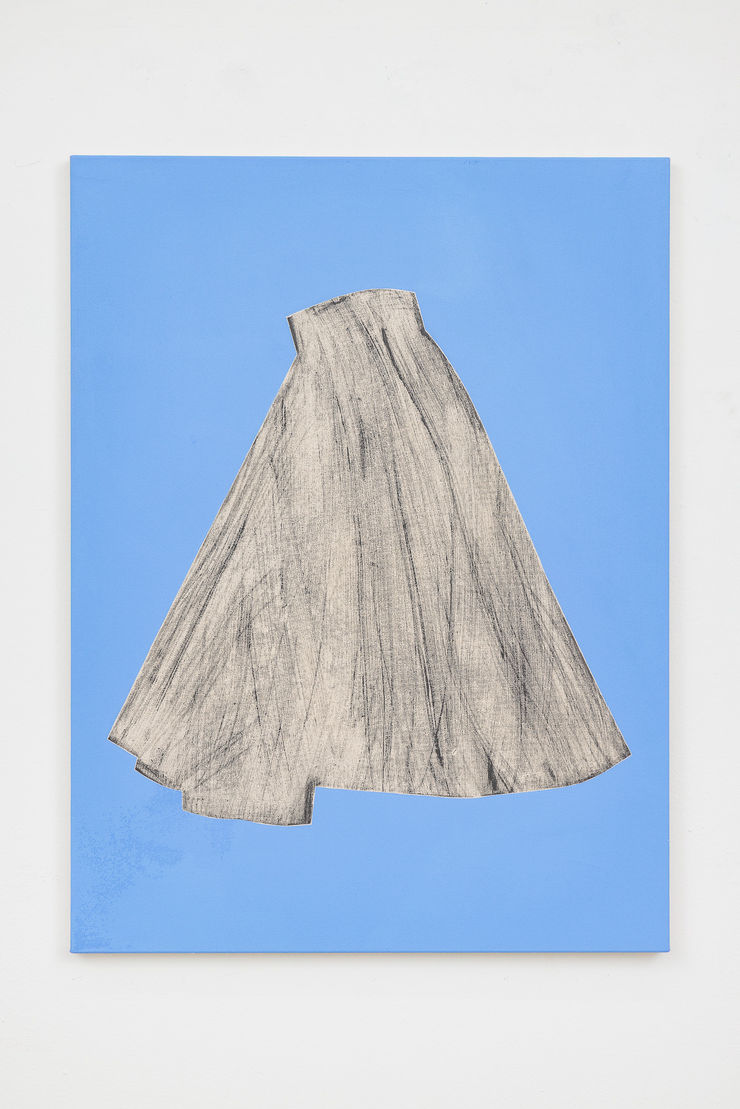
Frauke DannertSkirt (M02/26), 2026graphitpigment, dispersion, acrylics on cotton109 x 82 cm
42 7/8 x 32 1/4 in -
Frauke DannertLeaves (M03/26), 2026graphitpigment, dispersion, acrylics on cotton109 x 82 cm
42 7/8 x 32 1/4 in -
Frauke DannertUntitled (P01/24), 2024graphite, papercollage37,8 x 29,3 cm (framed)
21,1 cm x 29,7 cm (unframed) -
Frauke DannertStars (P02/26), 2026papercollage50 x 68,5 cm (framed)
57,3 x 39,1 cm (unframed) -
Frauke DannertSkirt (P04/26), 2026papercollage52 x 40 cm (framed)
29,7 x 42 cm (unframed) -
Frauke DannertUntitled (P01/26), 2026papercollage46 x 28,5 cm (framed)
19,3 x 37,1 cm (unframed) -
Frauke DannertSun (P03/26), 2026graphite, crayon, papercollage34,5 x 46 cm (framed)
37,1 x 25,5 cm (unframed) -
Frauke DannertFragile Twin (P02/25), 2025graphite, papercollage56 x 76 cm (framed)
76.2 x 57 cm (unframed) -
Frauke DannertFragile Twin (P05/25), 2025graphite, papercollage56 x 76 cm (framed)
76.2 x 57 cm (unframed) -
Frauke DannertFragile Twin (P01/25), 2025graphite, papercollage56 x 76 cm (framed)
76.2 x 57 cm (unframed)





Frauke Dannert, Doppelgänger
Fingers seem to reach for something elusive. Their silhouettes fall across the wall like shadows, evoking ghostly hands in negative form. They echo small-format paper collages in which graphite-coloured shapes drift, seemingly without direction. The pictorial space resembles the diffuse darkness of thought before words begin to form, or the primal chaos before physical forces came into being. Spaces where anything is possible because they resist fixed definition. Through the artistic process of frottage, real forms press themselves into the collages, flashing up as strangely familiar fragments that reassemble into entirely new constellations – a fragmented reality.
Frauke Dannert’s earlier work was marked by the dissection of architectural and vegetative structures, now she applies this approach to the artistic self. In a comparable manner, she explores how spaces of identity are defined and how they embed themselves within their surroundings. The components of the self lie like modular pieces in an open typesetting box: humanity arranged into order and structure, coolly broken down into parts on “templates,” neatly categorised according to aesthetic criteria, almost like on display boards. Forms with clearly defined edges take on a symbolic quality, pointing toward specific traits. How do we define identity? As the sum of its parts? Stars recall the European Union, yet they appear dark and distorted, as if lifted directly from a flag caught in motion. Fragmenting, isolating, and reconstructing, often from photographic source material, has long been an integral part of Dannert’s artistic practice.
A nose, an ear, a hand – in thought, these prosthetic fragments can be assembled into a self, opening up a wide field of associations. Two vessels may resemble one another and yet remain distinct; whether bulbous or slender-necked, each possesses an individual character and is never identical to the other. The motif of the doppelgänger, or the duplication of a figure, is something that appears frequently in art and literature. One might think of E.T.A. Hoffmann’s The Sandman, in which the protagonist is haunted by his own projection. For Freud, the doppelgänger mirrors the unconscious, the repressed, the darker side of identity. Today, the idea of a duplicated existence gains renewed relevance in the form of the virtual twin. Fed with physiological and medical data, it can predict the effects of medication or lifestyle choices. Dannert’s repeated noses also evoke social media, where surgically altered noses can appear almost identical. In her work, however, they retain individuality, varying in shape and size.
A doppelgänger bears an uncanny resemblance to another person. The principle parallels the market-driven demand for unmistakability in an artistic brand. At the same time, constant repetition risks a loss of self. According to Boris Groys, an image should contain everything that came before and anticipate what is yet to come. It must avoid repetition, break new ground, and yet remain rooted in history. The artistic self should dissolve within it, even as the work must still fit within a conceptual framework. Dannert’s noses and ears recall artists such as Hendrick Goltzius, who prominently integrated such body parts into his works. How much art history must, or may, be present in an image? Very much in the spirit of Samuel Beckett’s reflections on art: The Same Again, but differently.
The finished image becomes an Other that confronts its maker. How much of the artistic self resides within it, even when it is not a self-portrait? Perhaps the work reveals hidden aspects of one’s own personality, brought to light through the act of painting. The motif of the doppelgänger is already embedded in the collage itself, governed by principles of repetition, duplication, and mirroring. The source material is estranged, just as the artistic self is no longer directly visible in the image, only sensed. How much of Frauke Dannert is present in her works? Stars, oak leaves, a skirt, a high heel may each address different elements of identity. Could anyone assemble their own Dannert work from stencil-like templates? Or is it rather the diffuse in-between that creates connection, turning the small into the larger whole? Just as identity cannot be grasped through passport data, but only as a complex structure.
Artificial intelligence leads us to believe it may one day replace us: noses, ears, hands scanned and supplemented by memories uploaded to the cloud. Might the digital copy be a better, smarter, more capable, even more empathetic human? Or is it precisely our ambivalences and imperfections that define us? Although the contours of Dannert’s objects stand out sharply against their backgrounds, their clarity dissolves within the surface. Rough hatching, shifting between opacity and translucence, changes with the light. What appears easy to define begins to vibrate from within, developing its own pulse. There is a subtle noise, a moment of blur composed of countless shades of grey. A skirt falls into folds that might also be a mountain; noses resemble dark drops upon the supporting surface. Monolithic, sculptural features say little on their own; only together do they form a statement. Nuances, negative forms, and backgrounds are equally significant: forest green, salmon pink, mustard yellow, sky blue.
- Text Julia Stellmann
-
Frauke Dannert, Installation View: Doppelgänger, 2026 (Photo by Manuel Carreon Lopez)
-
Frauke Dannert, Installation View: Doppelgänger, 2026 (Photo by Manuel Carreon Lopez)
-
Frauke Dannert, Installation View: Doppelgänger, 2026 (Photo by Manuel Carreon Lopez)
-
Frauke Dannert, Installation View: Doppelgänger, 2026 (Photo by Manuel Carreon Lopez)
-
Frauke Dannert, Installation View: Doppelgänger, 2026 (Photo by Manuel Carreon Lopez)
-
Frauke Dannert, Installation View: Doppelgänger, 2026 (Photo by Manuel Carreon Lopez)


